

Almost every investor takes risks when investing in a startup. They look at it through the lens of potential loss and reward, and their main concern is how quickly and profitably a startup could grow. If you consider that just custom UX design for startups' success is enough, you will get disappointed. The task of each business founder is to persuade the potential financial donor that the game is worth the candle. This is where startup valuation can decide it all. However, traditional business valuation methods do not work for young businesses. Entrepreneurs should consider more specific approaches that reflect the strengths and potential of their venue. What are startup valuation methods? In this article, you will learn how to successfully value a startup for seed funding and beyond.
Why startup valuation is challenging
It is often a tricky thing to value a startup. It’s because it fully relies on estimations rather than facts. Startups often lack a steady track record, so valuations are built on projections, market trends, and growth plans and not on hard numbers. Investors rely on these estimates to determine if they can get a strong return on their money within the desired time. Different investors may also view value differently. For example, corporate venture capital (CVC) funds are more interested in access to startups’ innovative ideas, and traditional venture capitalists prioritize rapid growth and a clear exit strategy. So, startup valuation looks more like informed predictions than precise numbers, which can change quickly as the company evolves.
Factors influencing startup valuation
Startup valuation is a complex process that depends on many variables, both positive and negative.
Positive factors:
- Market potential. A big, growing market increases the startup’s value. If the business can tap into this market, it has a greater chance of success.
- Revenue and traction. Early revenue, customers, or market validation can increase the value. Even the tiniest progress gives investors confidence.
- Strong team. A team with experience, skills, and past successes often boosts the startup’s valuation, as investors love to support talents.
- Innovation. Unique products or technology that offer an advantage in the market can raise the startup’s value.
Negative factors:
- Lack of market proof. If a startup hasn’t tested its product or service in the market, it’s considered risky and may lower its value.
- Financial instability. If a startup struggles with cash flow or high debt, it automatically increases risk.
- Competition. Intense competition can make it harder for a startup to stand out.
- Legal risks. If a startup faces legal or regulatory issues, it can hurt its valuation because of the added risks.
Common startup valuation methods
Traditional valuation approaches cannot be used for an early-stage company valuation as it usually doesn’t have stable revenue. You need to use a blend of methods that assess all aspects of a young business and its growth potential. Here are the most popular.
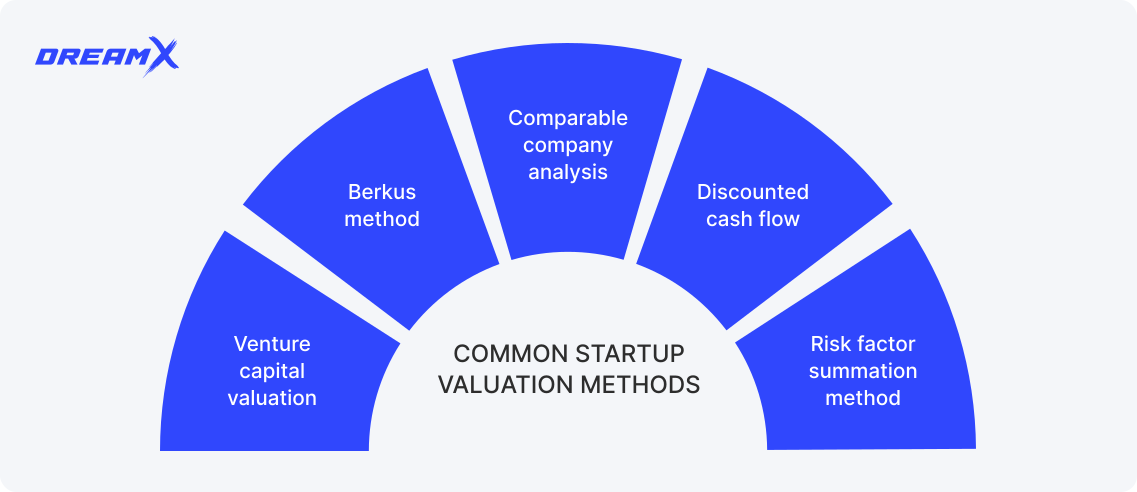
- Venture capital valuation
- Post-money valuation = Future value/Expected return
- Pre-money valuation = Post-money valuation – Investment
- Post-money valuation = $1 million /20 = $50,000
- Pre-money valuation = $50,000 – $25,000 (the investor’s money) = $25,000
- Berkus method
- Idea. If the business concept is strong, it adds up to $500,000.
- Prototype. A working model or prototype can add $500,000.
- Management team. A great team adds another $500,000.
- Strategic relationships. Partnerships or connections can bring in $500,000.
- Product or sales. Early sales or a product launch can add $500,000.
- Comparable company analysis (CCA)
- Find similar startups. List companies that are similar in size and industry.
- Rate important factors. Key factors like the team, market, product, and competition are scored based on how well your startup performs in each area.
- Apply weights. Each factor is given a weight according to its importance for that industry. Some factors, like the team, might be more important than others.
- Score the startup. Now, value a startup calculator and use a scale of 1-10 for each point.
- Calculate the value. Now, adjust the startup’s value based on the median value of similar startups.
- Discounted cash flow (DCF) This approach predicts how much money a startup will make in the future and, based on it, calculates its value for today. Here's how it works:
- Estimate future earnings. Predict how much revenue the startup will generate in the next 3-5 years.
- Discount this cash flow. Since money now is worth more than money in the future, you reduce the value of future earnings to cover this gap. Use a discount rate for this calculation.
- Add it up. Add all the adjusted amounts together to get the startup’s value today.
- Risk factor summation method
- Management
- Business stage
- Regulatory and political risks
- Manufacturing risks
- Sales and marketing risk
- Funding risks
- Competition
- Technology risks
- Legal risks
- International risks
- Reputation risks
- Potential for a profitable exit
This approach helps value startups with no revenue yet. It works with pre-money and post-money valuation. Simply put, it estimates what the company could sell in the future, then works backward to figure out its current value.
Here’s how it works:
For example, if a startup is expected to sell for $1 million and the investor wants a 20X return on a $25,000 investment, the calculation goes like this:
This is a simple way to value early-stage startups. It adds a specific dollar value to different aspects of the startup's potential.
There are several valuation multiples:
The total value of the startup is the sum of these factors, with a maximum of $2.5M. This method works well for very early-stage startups, helping investors quickly understand a company’s potential based on its key strengths.
This approach estimates the value of a startup by comparing it to other similar businesses. Here's a simple breakdown:
DCF is quite informative but not recommended for startups without a track record. It’s more reliable when the business is already established.
It combines elements of popular valuation modes (Berkus, Scorecard). It first sets a baseline valuation by comparing the startup to similar companies. Then, it adjusts the value based on 12 key risk factors in startups:
The Risk Factor Summation Method considers various factors when valuing a startup, including:
Each risk factor is assigned a score (e.g., +2 for low risk, 0 for average risk, and -2 for high risk). If the startup has many high-risk factors, its value is low.
Adjusting valuation based on funding stages
As a startup grows, its valuation changes at each funding stage (like Seed, Series A, Series B). It is critical to adjust the valuation and reflect its progress as it means less risk for investors.
For example, in the Seed stage, an idea and a good team might make a valuation of $1 M. By Series A, the startup could have a product and early users, and its valuation could attract to $5 M. In Series B, with steady business growth, it might reach $10+M. An adjusted valuation can create market buzz for a startup and demonstrate how it matures.
The role of equity and dilution in valuation
Equity is the ownership shares in a business. When a startup takes on investors, equity dilution happens. What does it mean? The startup owners get capital; they share their ownership with investors. Each owner now has a smaller piece of the total company. For example, if a founder owns 100% and then gives 20% to new investors, the founder’s equity stake is now 80% of the company’s total value. Although ownership percentages drop, the added funds can increase the company's overall value and benefit all stakeholders.
Key considerations for founders and investors
Founders and investors may focus on different things when they look at startup evaluation. So, what matters most?
For founders:
- Clear business plan. Investors need to see your goals, revenue forecasts, and growth strategy.
- Market potential. Investors want to see clear signs of profitability and scalability.
- Financial honesty. Provide transparent revenue projections.
- Team strength. A skilled and experienced team is your main asset.
Keep your plan updated as your startup evolves.
Use fair data to show the market’s potential.
Focus on metrics like cash flow and customer acquisition costs.
Highlight your team's expertise during pitches.
For investors:
- Risk vs. reward. Assess the risk level and the potential for returns.
- Market fit. Check whether startup’s product is what actually needed on the market.
- Exit strategy. Look for clear exit plans to make your investment more secure.
If risks are high, ask for more equity.
Research market trends to make sure the timing is right.
A strong exit strategy always reduces risk.
Case study / Example of a startup valuation
To better understand how to value a startup tech company in a way to help it move forward, let’s study the story of Griffin, a UK banking-as-a-service provider. The company was founded as the first API-based bank which aimed to reduce the costs of banking services for businesses. The progress was slow as the startup did not have the necessary legal permits and licences for all the operations. However, Griffin has successfully raised several rounds of funding to expand its platform. You can review its very first pitch here. It brought company $8.6 M of funding from EQT Ventures in 2020. Continuous valuation adjustment let Griffin progress very fast:
In 2022, the company secured £12.5 million in a round led by Notion Capital.
Its Series A funding round in 2023 brought in $13.5M.
In 2024, the company managed to attain a full banking license and raised $24M to help scale its operations and enhance its infrastructure.
Conclusion
Valuation is crucial for startups because it helps determine how much a company is worth. A proper and transparent valuation attracts the right investors, helps secure funds, and sets a solid foundation for growth. It also helps business founders to scale, hire the right people and form strong partnerships. A too high or too low valuation can scare off potential investors or limit funding for startups. On the contrary, a startup that can clearly estimate and demonstrate its value can easily hook an investor. If you are not sure your startup valuation is fully correct, it’s always a good idea to seek professional help. Although valuation isn't our expertise, we can help you craft an impactful pitch deck and develop an MVP. If you need support in these areas, just reach out to us. We’d be happy to help your startup!